
 WSET® Certification
  Choice of classroom and/or online
  Personalised approach
  LifeLong Learning
  Also in your company
Lukas Wiegman DipWSET
Sommelier @NOTK Rotterdam
Let’s start at the beginning: how did your journey as a wine professional begin? How did you become a sommelier?
My first experiences with wine happened while studying at the Hotel School, The Hague. I did a basic wine course there. To be honest, that was purely because we got to drink early in the morning, and it was super fun. [laughs] But I still remember, I wasn’t super committed to wine back then. When I graduated in 2015, I just wanted to start with a good title and have this hotshot career and earn a lot of money. I started to work for a consultancy company in Amsterdam.
But I really didn’t feel at ease. I felt that this path wasn’t exactly mine… Meanwhile, being based in Amsterdam, I started going out for dinner often, buying wines for home, reading books, and getting more and more interested in wines. After some soul-searching, it became clear to me that maybe I should go back into the restaurant scene. I already had experience from part-time jobs. When there was a sommelier doing a wine pairing, it looked so fun to me. I always really enjoyed hotels and restaurants: magic places where it’s not only about food but the whole experience and giving people a warm, welcome feeling. I thought that was super interesting.
In 2017 I went to South America for a sabbatical. I visited wineries in Argentina, and Chile and thought: “This is super interesting!” Later that year my former boss helped arrange a winemaking internship in the Loire Valley. That’s when everything started. I was there for two months at a small natural winery in Montlouis-sur-Loire, Lise et Bertrand Jousset, focusing predominantly on Chenin Blanc. It was eye-opening. I came from the big city. I always lived in big cities. And suddenly I was in the countryside, following the rhythm of nature. Every day we had a big lunch from their own garden – it was fascinating!
I realized that visiting wineries, seeing the landscape, and witnessing all the meticulous time, energy and craft behind a bottle became really fascinating for me. Wine became my gateway to learn more not just about restaurants and fine dining, but about life and nature. This was the path I wanted to follow.
When I came back, I started applying for a sommelier role and became a sommelier at FG in Rotterdam.
 Thanks for sharing the story about finding your path. You recently completed the DipWSET and earned the title The Best Sommelier of the Netherlands. Both achievements demand serious dedication. What drives your growth and keeps you motivated?
I’ve always been a person who likes to perform and appreciates challenges. I was already playing at a professional football club at the age of 9-10. The competition was very challenging; every year new guys entered the team and you had to fight for your place. My exam scores after primary school allowed me into the highest level of secondary education. This motivated me to commit fully to school. Even though my teachers said, “You will never finish it,” I did – in seven years instead of six [laughs].
I’ve always been driven to maximize everything I do. And I love it. Sometimes it feels like a downfall, because I’m always stressed, always trying to prove myself, taking on challenges that make most people say: “Okay, just calm down and back off!” But this is how I love to live my life. Even while studying for my WSET Diploma, I was also preparing for the Best Sommelier of the Netherlands competition, starting my own company, and moving to a new restaurant location – all at the same time.
I just want to be the best version of myself. Nothing in life is granted; great stuff requires hard work. As soon as you realize that and start building a very consistent and persistent attitude towards life, I think this really helps you to flourish. Life isn’t always nine hours of sleep and sunshine. Well, everyone is excited for life, and ready to accomplish all the tasks when they feel fully rested and mentally strong… But this is not life. Many days you wake up already exhausted and stressed. If you can still get the right work done on those days, that’s important. Do a lot of hard things, and a lot of good things happen.
How would you describe your experience studying with WineWise? What were your expectations, and did the course meet them? What is the most significant contribution this education has made to your career?
I loved how the course is designed and planned. You learn directly from MWs – that was something really beneficial. The impressive level of professionalism, experience and the amount of careers that these people have had, and you’re just sitting in the same room with these people! It is just really awesome! The WSET Diploma is massive and comprehensive, and WineWise knows what they’re doing and manages the studying in a very effective and efficient way. As soon as you start this program, they give you all the tools and all the tricks to make it happen, even though you have to study quite a bit by yourself. The MWs who teach and share their experience with you are incredibly valuable. It’s not just about gaining the next level of detailed wine information — that’s not the purpose of the course.
The course teaches a holistic approach to wine, not just blind tasting or the main regions. I thought I knew things from years as a sommelier and national competitions, but the way they teach you to study, write reports and essays, and examine topics deepened my knowledge and understanding of the wine world as a whole. It gave me tools I now use as a buyer and importer: assessing price/quality, consumer perception, and whether something is an opportunity or a threat. That’s what I really valued about the WSET Diploma course.
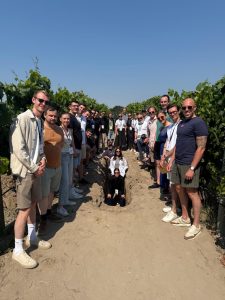 What were your key insights and takeaways from your recent educational trip to California?
I only went for a week, but I saw so many different climatic conditions, growing approaches, subregions with different soil types and grape varieties, different wine making styles, and also very diverse expressions of the wine. For many consumers and professionals, California means Napa Valley and big, extracted Cabernet Sauvignons. But I’ve tasted very different styles of wine there: like super old bush vines of Cinsaut on pre-phylloxera roots, and almost Burgundian-style Chardonnays from Santa Rita Hills. It was really awesome to see the diversity of only one state in the USA and find out that California is a multi-layered region. This is my biggest takeaway. Also, the stereotype of “Californian style of wine” has changed for me. Today Californian wines don’t necessarily scream new oak anymore and are not overloaded with high alcohol and super jammy flavors.
I really came back thinking that California is such a diverse and evolving region for wine. Check out our Capstone California Course.
Please introduce your current project, Notk. What is the concept behind it, and what is your role and vision?
I’m co-founder with my good friend Thomas; we worked together as sommeliers at FG. We asked: “What does Rotterdam need?” We felt a gap between fine dining and wine bars – an approachable place where you can drink very good wines without spending a fortune on food and wine list.
We tested the concept with a pop-up at the Supernova Hotel. COVID showed how fragile restaurants can be, so we made the model more sustainable by also importing wines. Thomas mainly runs operations of the restaurant and I handle imports. We import almost exclusively 15 boutique wineries from classic regions. We love the classic regions, but not always choose the most classic expressions of them. For example, we prefer a new wave style of Burgundy. We have chosen a producer from the Côte des Bar, Champagne, which is only making vintage style champagnes, but in a very clean and refreshing, not super autolytic and heavy on the brioche and the pastry kind of aromatics style. We do some biodynamic Riesling and Grüner Veltliner from the Kamptal, some Barolo, Brunello di Montalcino, some Rioja too, but we prefer the new wave style Rioja. We like to play with what we think are “sommelier wines” and introduce them here in Notk.
We organize winemaker dinners to introduce producers, and the restaurant acts as a showroom. Our guests really enjoy the wines they drink here and they become private customers. We try to be good hosts and ambassadors for wine in the Netherlands, but most importantly – in Rotterdam.
How do you build your wine list at Notk? How do you balance personal preferences, discoveries, and guest needs? With the deep knowledge and experience you gained there must be so many temptations…
I have to admit: at first, the list mirrored our own palate. But we quickly realized we needed a shift. For example, we didn’t have any super oaky white wines by the glass, because it didn’t seem necessary to us. But we learned the balance of navigating guests toward something new and listening to what they want.
I still think we are very much on the sommelier side of the wine-list of things, with some very exceptional niche producers from Burgundy, Champagne. But today we also have some very oaky, big, juicy whites, but also reds. In Rotterdam here a lot of people love to drink oaky Chardonnay and they love to drink big either Italian reds or Spanish reds with a lot of oak. And, for example, Amarone is a style of wine that I really enjoyed when I started discovering wines. But not anymore: I drink one glass and I feel saturated. But now we sell a lot of Valpolicella Ripasso and Amarone, so I think our wine list is really playing into our guests’ needs as well. This is massively important.
There has to be a balance. We can inspire certain guests to discover some new styles they never tried before. But I also feel that sometimes the best thing you can do is just to listen to your guest. If someone wants to have a super oaky American oak style of Chardonnay, it might not be my personal preference, but the guests are paying, so I need to take them into consideration.
As we focus on only European wines, we don’t have wines from the New World. Sometimes I really feel a bit bad about it, because there are so many cool projects that I would love to represent. But this is our choice. Europe produces an incredible range of outstanding wines, and that is where we focus our attention. Champagne, Burgundy, and Italian red wines hold a prominent place in our selection. It’s a direction we choose very deliberately.
Maintaining a healthy stock is essential here. If you just keep buying wine and it doesn’t sell, that is not a healthy situation. So, we keep a small wine list. Of course, I would love to have a bigger wine list, but I am forcing myself to not go over, let’s say, 250 or 300 references. Meaning, I have to make really good decisions… But you know what I’ve noticed? I’ve worked in restaurants with no budget limit and endless winelists, but here the challenge is making hard choices – and I really love this kind of stuff! And, again, another hard challenge [laughs].
 What’s your most recent food-and-wine pairing discovery?
Oh, difficult question! Whenever I go out to a fine dining restaurant, I always drink by the bottle. As much as I love to discover wine and food, it’s also very important for me to enjoy what I drink when I go out. And most pairings are always very subjective to the palate of the sommelier.
However, recently in Notk we created a fantastic combination. We have a“Sommelier’s menu”: we pick 4 wines and pair them with 4 dishes. We always choose the wine first, then bring it to the kitchen and discuss with the chefs: which seasonal products we can use, what can be the pairing for this wine. And from there on every time it is a very interesting discovery. Recently we created a very cool wine pairing! The wine we have chosen is a red blend of indigenous varieties from Portugal, the Azores islands by António Maçanita. It includes varieties like Mourisco Tinto, Touriga Nacional and I think some Tinta Roriz as well. The wine looks very light, with this kind of garnet hue, and has an impressive aroma of rooibos, the South African tea. On the palate it has these beautiful bright red fruits with an amazing kind of smokiness. For me this is a direct association with the volcanic soils expression in wine. Also, it has some salinity as well. Together with a fruit ripeness, this wine has some very savory, salty finish.
Our food pairing for this wine became a duck with chipotle, a kind of jus de veau sauce (with smoky notes too) and some harissa as well. The duck is not too fat or too intense in flavor, it does not overwhelm the flavors. And these herbs really enhance the smokiness. For me, it’s really something that plays along into the autumn menu. I really like how fruit flavors and smokiness play together and complement each other so nicely.
You’ll represent in 2026 the Netherlands at the Best Sommelier of the World competition in Portugal. How are you preparing for this event?
[exhales sharply] I study every day. I make my own flashcards with AlgoApp. It really helps me with all the theoretical and sec knowledge: dates, numbers, facts. I think the best thing I can do is to study every day. What is the maximum yield of Musigny Grand Cru for red wines? What is the first vintage of Clos des Goisses? What is the first vintage of Pingus? Who is the winemaker? You don’t need a lot of reasoning for it, unless you go into a lot of detail, like describing a certain style. But I think this theoretical knowledge for competitions is very important because they test how much you know. And it’s a never-ending study. You can go as deep as you want to, and it’s really a lot. Therefore, I really love to make flash cards to anchor that knowledge. I sometimes do up to 150 flash cards a day. And if you do it every day – Boom! – the knowledge starts to get there. I feel like you really can get a lot of knowledge in your head by studying a lot.
Tasting prep is tough because they can pour anything, not just classic wines. In the last European competition, we had white Zinfandel, an aged Tavel rosé, and even a blind beer flight. I study a lot with Thomas; we give each other blind flights, and colleagues are building a library of classics so we can taste constantly. But I do feel that I need to work even harder on this. I feel that I always describe the wine well, but the conclusion, as we all know, is sometimes so tough. Practicals require a lot of repetition as well.
The more I fail… and failing is not maybe the right word…. the more I make mistakes and get pressured by these exam/deadline scenarios, the more I can learn and better I become in the end. I just need to fail my way to success. I need to do things 100 times, and I need to make 99 big mistakes, and then the 100th time, I’ll do it right. This is really hard: train with your peers and make silly mistakes and feel stupid. But I never give into this feeling, because if I do, I quit trying. And that’s when you stop growing. By making one mistake after another, you learn. And if you are consistent and just continue doing your thing, then once the competition is there, you can fly and you can be the best version of yourself. And also, I just see the fun of it, you know?
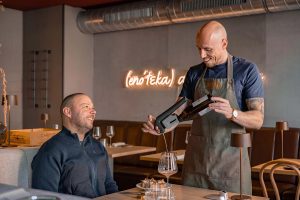 Sure! It seems that pressure works for you just like for a bottle of champagne – it helps to evolve and reach the next level of development [laughs]. Good luck with your preparation and self improvement! Any final tips you can share?
Just make it fun. This is something that I love. I love the challenge. Do I love studying everyday? Do I love that extra pressure I put myself under? No, not always, but I like to make it fun. I try to stay humorous, relaxed, chill and not get wound up over little things. Of course I want to reach the finals, but instead of “what if, what if,” I tell myself: “No, man, I’m going to have fun. This is what I love to do. I’ll prepare the best I can. And once it’s there – Boom!- I’ll let it all out.” And this is what really helps me. If I only put pressure on myself, it would never work.